

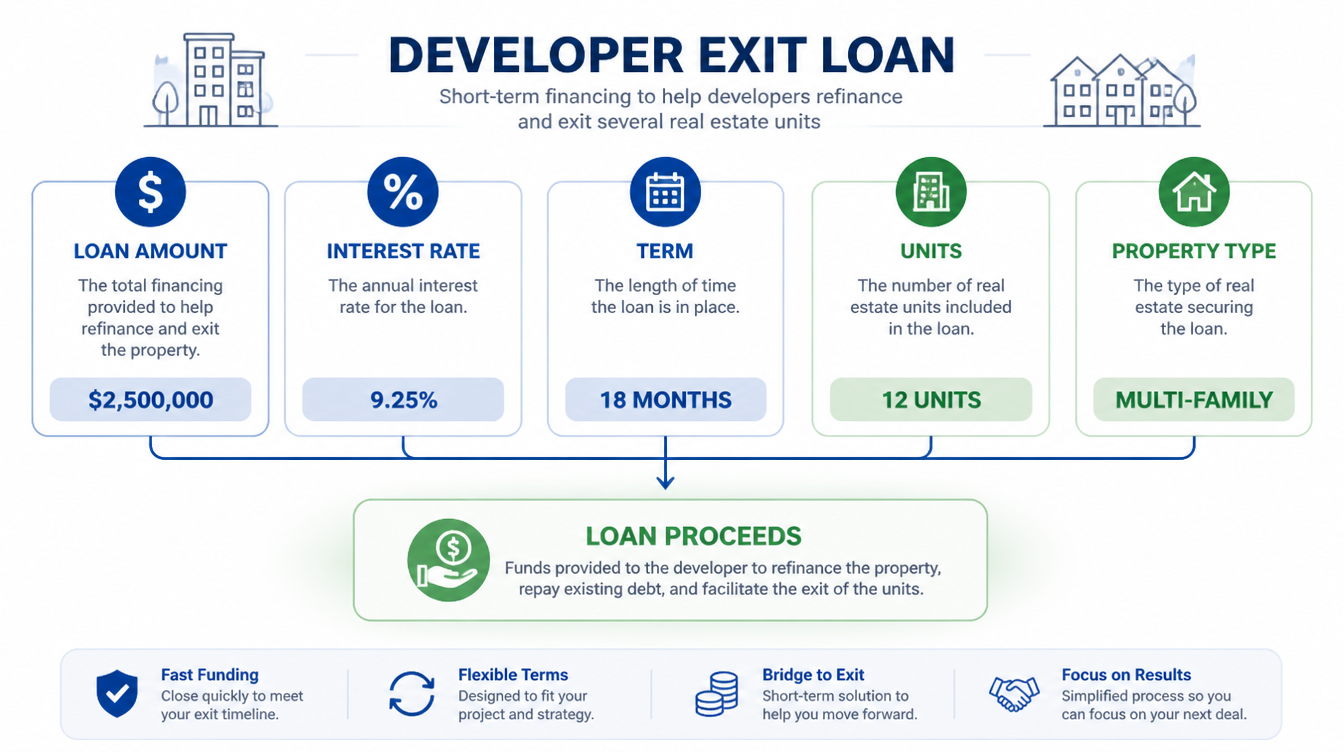
How to structure a multi-unit developer exit loan in the UK
A multi-unit developer exit loan is short-term property finance that can refinance an existing development facility once a scheme is completed or sufficiently close to completion. It gives the developer a defined period to sell individual units, sell the block, refinance retained units or combine these exits. The structure matters because each sale must also satisfy the new lender’s security-release and partial-repayment conditions.
For a block of flats or a collection of newly built houses, the relevant questions are not simply how much the entire site is worth. A lender will consider which units remain, their individual values, current development debt, completion documentation, legal title, sales evidence, the proposed unit release prices and the repayment date. An exit facility does not automatically remove sale pressure, guarantee higher prices or make cash available for the next project.
This UK guide explains the lending mechanics, a worked eight-unit example, sale-by-sale release requirements, potential refinance structures and the checks needed before the original development loan matures. Lockwell’s developer exit finance service covers the wider funding route.
When does a multi-unit developer exit loan make sense?
Development finance is designed to support construction, staged drawdowns and the building phase. As works finish, the developer may still have unsold units, even though the original loan is approaching maturity. A developer exit bridge can potentially replace that debt with a loan secured on the completed or nearly completed units.
- Finished units remain unsold: the developer needs a realistic period for viewings, exchange, buyers’ mortgages and legal completion.
- A partially sold scheme: some units have completed and the lender will take security over the remaining eligible homes, valued and documented individually.
- Near-complete construction: certain lenders may consider a scheme with limited, defined outstanding works and an acceptable budget, although others require full practical completion and building-control sign-off.
- Phased releases: the lender agrees how much must be repaid from each completed sale before removing its legal charge over that unit.
- Investment retention: the developer intends to keep part of the scheme for rent, with a credible Buy-to-Let, multi-unit or commercial refinance plan.
- Short-term existing-loan maturity: refinancing may avoid an immediate forced sale or costly extension, but the replacement facility has its own costs, maturity and underwriting.
One specialist lender, GB Bank, publicly describes developer exit lending for completed and near-complete phased developments. This is evidence that such structures exist, not a Lockwell rate quotation or a guarantee that the project qualifies.
Development finance versus developer exit finance
Development finance usually assesses land, construction costs, remaining work, contractor delivery, a build programme and completed gross development value (GDV), with advances potentially released against verified works. Developer exit finance commonly focuses on completed security, sales or rental prospects and a defined redemption route. It may be assessed on the lender’s current valuation of the finished or sufficiently completed property.
A standard bridging loan may be an option for some schemes, but a genuine multi-unit exit often needs more detailed legal documents than a simple single-property bridge. The agreed release mechanism, security over common parts and the treatment of each apartment or house can be critical. Read development finance and development finance versus bridging finance for a comparison.
The core loan structure: valuation, debt and repayment
1. Establish the value of the remaining security
List every property still owned by the borrower, with a unit number, size, tenure, floor, finish, marketing price, independent valuation and expected buyer or tenant. A lender may obtain individual values, a block value, or both. The sum of retail asking prices is not necessarily the amount the lender would receive from selling the block or repossessing it.
Some lenders apply a discount to the aggregate retail value where several units are to be sold together, reflecting absorption time, buyer concentration and the costs of disposal. The accepted loan-to-value (LTV) must be measured against the lender’s valuation basis, not a sales brochure or an unverified GDV.
2. Calculate the debt required to redeem the development lender
Obtain a recent redemption statement showing the original lender’s principal, outstanding interest, fees, any prepayment or exit charges and the proposed redemption date. Confirm whether all its charges and restrictions can be discharged on completion of the new loan.
A developer exit facility must normally provide enough net proceeds to repay the previous lender and transaction costs. A gross approval larger than the old loan is not sufficient if retained interest, arrangement fees, monitoring costs and legal charges absorb the difference.
3. Agree the sale-by-sale partial redemptions
Before signing the new facility, agree a minimum release price or partial-repayment formula for each unit. When a unit sells, the lender receives the required sum, then releases that unit from its charge so the buyer can obtain clean title. This is different from giving the developer unrestricted access to all sale proceeds.
Release prices can vary by unit value, security mix, loan balance or lender policy. Some lenders also impose a sales waterfall, a minimum interest amount, a cash sweep or a rebasing of the outstanding LTV after each sale. The developer’s solicitor must coordinate the agreed discharge of security for each completion. Specialist developer exit lending guidance confirms that partial repayments can accompany phased unit sales.
4. Test the exit before setting the term
A credible programme includes marketing, reservations, exchange, purchaser finance, conveyancing, completion and debt redemption. A reservation is not a guaranteed completion; a chain or mortgage valuation can still fail. Build in a downside scenario for slower sales, reduced prices and an incomplete refinance. The new facility has its own maturity date and may involve additional costs if the exit slips.
Worked example: refinancing an eight-unit development
Consider a hypothetical scheme with eight new-build flats. Each flat is estimated at £300,000, giving a combined retail value of £2.4 million. Assume the remaining development lender requires £1.3 million for redemption, including the specified outstanding debt at that date. These are illustrative figures, not a completed case or an actual lender quotation.
- Remaining units: 8 flats × £300,000 estimated retail value = £2,400,000.
- Development loan to redeem: £1,300,000.
- Hypothetical developer-exit LTV ceiling: 65% of £2,400,000 = £1,560,000, if the lender accepts that value and LTV.
- Proposed new gross exit loan: £1,400,000, below the illustrative ceiling.
- Apparent difference before any deductions: £1,400,000 − £1,300,000 = £100,000.
- Illustrative equal release price: £1,400,000 ÷ 8 = £175,000 per flat, but only if this is expressly agreed by the lender.
On one hypothetical £300,000 flat sale, the agreed £175,000 release payment would reduce the outstanding principal from £1,400,000 to £1,225,000. The gross difference of £125,000 is not automatically cash the developer keeps: selling costs, interest, any other contractual repayment requirements, taxes and retained amounts may have to be paid. Another lender may set a higher release figure for that unit or reassess the remaining portfolio’s LTV.
The apparent £100,000 refinancing surplus may also disappear after the new lender’s arrangement fee, retained interest, valuation, legal fees and redemption costs. If the lender applies a lower block valuation, its maximum advance could fall below the proposed amount. The example assumes no additional value discounts, refinancing charges or sales shortfalls; a genuine project appraisal must include all of them.
How much does a multi-unit developer exit loan cost?
Costs can include the lender’s interest, arrangement fee, valuation of the block or individual units, lender and borrower legal work, brokerage, title restructuring, insurance, possible monitoring and facility extension or exit fees. Some lenders retain or roll up interest, while others require ongoing payments. Compare actual lender terms, not an advertised monthly rate on its own.
For the same illustrative £1.4 million loan, assume 0.75% simple monthly interest, a nine-month term and a 1.5% arrangement fee. If none of the loan were repaid during those nine months, simple interest would be £94,500 and the arrangement fee £21,000, or £115,500 combined before other charges. If units sell and the balance falls earlier, actual interest may differ materially. Compounding, retained interest and minimum-interest terms can also change the result.
These assumptions are not current advertised rates, an offer or a prediction. Ask each proposed lender for a completed cost schedule, net advance, redemption figures for several sale dates, partial-release fees, any minimum interest and extension conditions. See how to compare developer exit loans and development finance costs.
Practical completion, legal title and certificates
For a multi-unit block, building work being physically finished is not always the same as having every document needed for a mortgageable sale. Before moving to exit finance, check which certificates, legal titles and consents the lender and individual buyers require. A lender may be unwilling to release funds against units that cannot yet be sold or refinanced.
- Building control: applicable completion certificates or approvals, including any conditions or outstanding inspection matters.
- New-home warranty: recognised structural warranties or other suitable arrangements where purchasers and their mortgage lenders require them.
- Title and leases: registrable titles, compliant flat leases, rights over communal areas, easements, shared services and a workable management or service-charge structure.
- Planning compliance: discharge of relevant planning conditions and any section 106 obligations affecting lawful occupation, use or sale.
- Fire and building safety: fire strategy and appropriate documentation; certain taller residential buildings in England can have additional Building Safety Regulator requirements.
- Utilities, roads and access: connections, easements and any adoption, estate-management or highway matters that buyers’ conveyancers or lenders will investigate.
- Energy and marketing documents: the applicable EPC and accurate property details, together with unit-specific information for the buyer’s solicitor.
For certain higher-risk residential buildings in England — generally at least 18 metres high or seven storeys with two or more residential units, subject to the legal definitions — the Building Safety Regulator has a specific full or partial completion-certificate process. Where applicable, the building must also be registered before occupation. A partial completion strategy is a formal process, not permission to occupy any finished-looking floor. See the government’s higher-risk-building completion guidance.
The relevant building control, title and registration rules differ between England, Wales, Scotland and Northern Ireland. Seek appropriately qualified legal and building-safety advice for the actual site rather than using a generic checklist as proof of compliance.
How can the developer sell units in phases?
The lender’s requirements should be considered before the sales agent promises exchange or completion dates. Unit prices and release sums should work together so that the facility becomes safer as the developer sells homes, rather than leaving the lender holding too much debt against a shrinking number of units.
- Agree the unit schedule: property identifiers, current values, expected prices, release amounts and order of sales.
- Document partial discharges: conveyancers need an agreed procedure to pay the lender and release its charge at each sale.
- Manage the remaining loan: after every completion, recalculate secured debt, remaining collateral value and interest due.
- Review sales absorption: do not assume eight similar apartments will all exchange or complete simultaneously; consider competing developments and mortgage availability.
- Retain evidence: track reservations separately from exchanged contracts and actual completions, and update the lender promptly.
- Allow for costs: agent fees, service-charge liabilities, site maintenance, insurance and debt servicing continue until the loan is redeemed.
A phased-sales strategy may avoid marketing every unit as a single bulk investment, but it does not guarantee higher prices. A block sale can complete more quickly in some situations, although its valuation may be different from the sum of individual retail values.
What if the developer wants to keep some units?
A mixed exit may involve selling several units to reduce the bridge and refinancing the rest on a suitable longer-term Buy-to-Let, multi-unit freehold block (MUFB) or commercial facility. The retained properties need to satisfy separate underwriting for rental income, ownership, title, planning, valuations and borrower circumstances.
For instance, a developer may sell five flats and retain three for long-term rental income. The developer exit lender needs a plan for releasing sold titles, and the proposed permanent lender must confirm that the remaining properties and rental income can support enough borrowing to repay the balance. A hoped-for rental valuation is not the same as a mortgage offer. See Lockwell’s MUFB mortgage guide and development finance exit to remortgage.
What lenders will ask before offering exit finance
- Borrower and borrowing entity: company or SPV structure, directors, beneficial ownership, development track record, financial position and existing commitments.
- Existing development loan: facility documents, current redemption statement, loan maturity and charges requiring discharge.
- Unit inventory: floor plans, unit sizes and tenure, completed and unsold units, sales prices, reservations, exchanges and actual sale completions.
- Valuations: evidence for both individual-unit prices and any relevant block or investment valuation.
- Completion and legal documents: building-control certificates, structural warranty information, planning conditions, leases, title plans and any other lender-specific reports.
- Sales programme: appointed estate agents, local comparables, realistic marketing periods and agreed release prices.
- Cash-flow and exit: net refinancing requirement, interest and fee reserve, holding costs, maturity date, sale downside and potential term-finance assessment for units being kept.
Where a scheme is still substantially under construction or has significant work unfunded, development finance or a refurbishment facility may be more suitable than a completed-scheme developer exit product. Do not rely on an exit loan until the lender has assessed the actual stage of work and remaining costs.
Common mistakes to avoid
- Confusing gross and net proceeds: headline loan amount can exceed what is available to repay the original lender after fees and retained interest.
- Assuming all sale proceeds are unrestricted: the release-price covenant determines how much must be paid to the lender for each discharged unit.
- Using asking prices as valuations: a lender may apply a block discount or value the remaining units differently.
- Ignoring unsold stock costs: business rates or council tax where applicable, utilities, insurance, security and service charges can continue.
- Overlooking title and certification: a finished flat may still be impossible to sell promptly if its legal or building paperwork is incomplete.
- Assuming rental refinance: a permanent lender can lend less than projected or decline the property or borrower.
- Relying on automatic extensions: a developer exit bridge has a fixed repayment date, and extensions can incur additional costs or be refused.
How to arrange a multi-unit developer exit loan
- 1. Map the remaining units: record value, title, sale status and completion documentation for each home.
- 2. Calculate the existing redemption: obtain a dated figure from the development lender and confirm what security must be discharged.
- 3. Define the exit: decide which units will be sold, retained or marketed as a block, with realistic timing.
- 4. Model the loan: compare the net advance, costs, valuation basis and potential LTV with the required redemption.
- 5. Negotiate release terms: agree the partial-repayment amount and legal release procedure for each proposed unit sale.
- 6. Complete valuations and legal checks: establish title, warranties, building control, remaining work and lender security requirements.
- 7. Monitor the exit: reconcile each sale to the outstanding loan and update the exit timetable if prices or buyer activity change.
To assess a specific UK scheme, review Lockwell’s developer exit finance service or send the unit schedule, existing redemption figure and proposed exit plan. The suitability, terms and availability of any facility depend on underwriting, property and regulatory circumstances.
Multi-unit developer exit finance: frequently asked questions
What is a multi-unit developer exit loan?
It is a short-term property-secured facility that may refinance the remaining development debt on completed or sufficiently near-complete schemes containing several units. Repayment is commonly planned through unit sales, a bulk sale, a later mortgage or a combination.
Can I obtain a developer exit loan before every unit is finished?
Some lenders may consider defined minor outstanding works with a clear completion plan and suitable security; others require practical completion and appropriate certificates. A substantial construction budget may still require development finance.
What is a unit release price in developer exit finance?
It is the minimum agreed amount payable to the lender when a particular unit is sold so the lender releases its charge on that unit. It is negotiated in the facility and can differ across units.
Can a developer keep all the proceeds from each flat sale?
Not automatically. The lender normally receives the contractual partial redemption before releasing the unit. Fees, interest, sales costs and other liabilities can also reduce what remains for the developer.
How does loan-to-value work for a block of new flats?
The lender compares proposed borrowing with its accepted value of the security. That value may differ from the sum of individual asking prices and may reflect a block-sale discount, marketability or remaining lease/title issues.
Can I use developer exit finance to release equity for a new site?
Potentially, but only if the net advance exceeds the development-loan redemption and all relevant costs, the lender permits the use of funds, and the remaining security and exit satisfy its criteria. Equity release is never guaranteed.
What documents are needed for a multi-unit developer exit loan?
Common items include a dated development-loan redemption, unit schedule, valuations, sales evidence, titles and leases, planning and building-control information, warranties and a credible sale or term-refinance plan.
Can I refinance unsold flats onto a multi-unit Buy-to-Let mortgage?
Possibly. A term lender must separately assess retained flats, ownership, rental income, value, legal title, property standards and borrower circumstances. It may not advance enough to redeem the developer exit facility.
What happens if I cannot sell all units before the loan ends?
The outstanding debt still becomes due. Extension terms are not assured; extra interest, costs and enforcement against secured properties may follow. Stress-test slower sales and lower prices before borrowing.
Reviewed 3 November 2026. General UK property-development and finance information, not a lender offer, project valuation, legal opinion, tax advice or regulated mortgage recommendation. The correct building-control requirements, planning position, lending terms and security releases are site-specific and should be confirmed by appropriate professionals. Lockwell Finance states that its advice is not FCA regulated; where regulated mortgage advice is required, consult an appropriately authorised firm. A property may be repossessed if a loan secured on it is not repaid.
