
Can You Legally Avoid Stamp Duty?
You cannot simply opt out of paying Stamp Duty Land Tax when it is legally due. However, you may be able to reduce your bill or pay no SDLT if your purchase falls below the relevant threshold, qualifies for an established relief or exemption, or gives you the right to reclaim a surcharge later.
The correct result depends on factors such as:
- The property’s purchase price
- Whether it will be your only property
- Whether you are replacing your main residence
- Whether every purchaser is a first-time buyer
- Whether you own or part-own property outside the UK
- Your residence status for SDLT purposes
- Whether the purchase is residential, non-residential or genuinely mixed-use
- Whether the transaction qualifies for a specific statutory relief
This guide primarily covers Stamp Duty Land Tax in England and Northern Ireland. Property purchases in Scotland are normally subject to Land and Buildings Transaction Tax, while purchases in Wales are subject to Land Transaction Tax.
Current Stamp Duty Rates in England and Northern Ireland
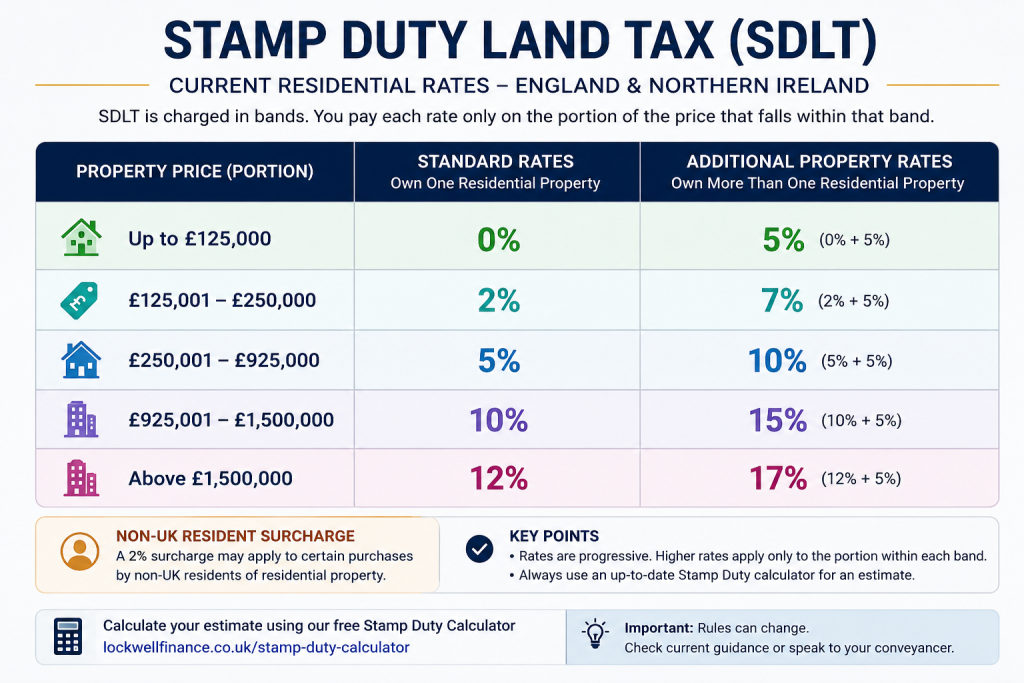
For an ordinary residential purchase that will leave you owning only one residential property, the standard SDLT rates are:
- 0% on the portion up to £125,000
- 2% on the portion from £125,001 to £250,000
- 5% on the portion from £250,001 to £925,000
- 10% on the portion from £925,001 to £1.5 million
- 12% on the portion above £1.5 million
These are progressive bands. The higher percentage is charged only on the part of the price within that band, not on the property’s entire purchase price.
If the purchase means that you will own more than one residential property, the higher SDLT rates will usually add five percentage points to each standard band. A separate 2% surcharge can also apply to certain non-UK resident purchases.
Use a current Stamp Duty calculator for an initial estimate, but ask your conveyancer or a qualified property tax adviser to confirm the final calculation before completion.
Understanding Stamp Duty in the UK
Stamp duty, formally known as Stamp Duty Land Tax (SDLT), is a tax imposed on property purchases in the UK. The amount you pay depends on the property’s price and the applicable SDLT rates, which are tiered based on the value of the property. For instance, properties priced under £125,000 typically incur no stamp duty, while those exceeding this threshold are taxed at varying rates, escalating as the property value increases. The current rates for residential properties are structured as follows:
- 0% on the first £125,000
- 2% on the portion from £125,001 to £250,000
- 5% on the portion from £250,001 to £925,000
- 10% on the portion from £925,001 to £1.5 million
- 12% on the portion above £1.5 million
Understanding these rates is crucial for effective stamp duty planning. Proper planning can help you identify potential savings and avoid unexpected costs during property transactions. Engaging in stamp duty planning allows you to explore various strategies to legally reduce your stamp duty bill. This can be particularly beneficial in high-value transactions where the tax burden can significantly impact your overall investment.
Legal Ways to Reduce Your Stamp Duty Bill
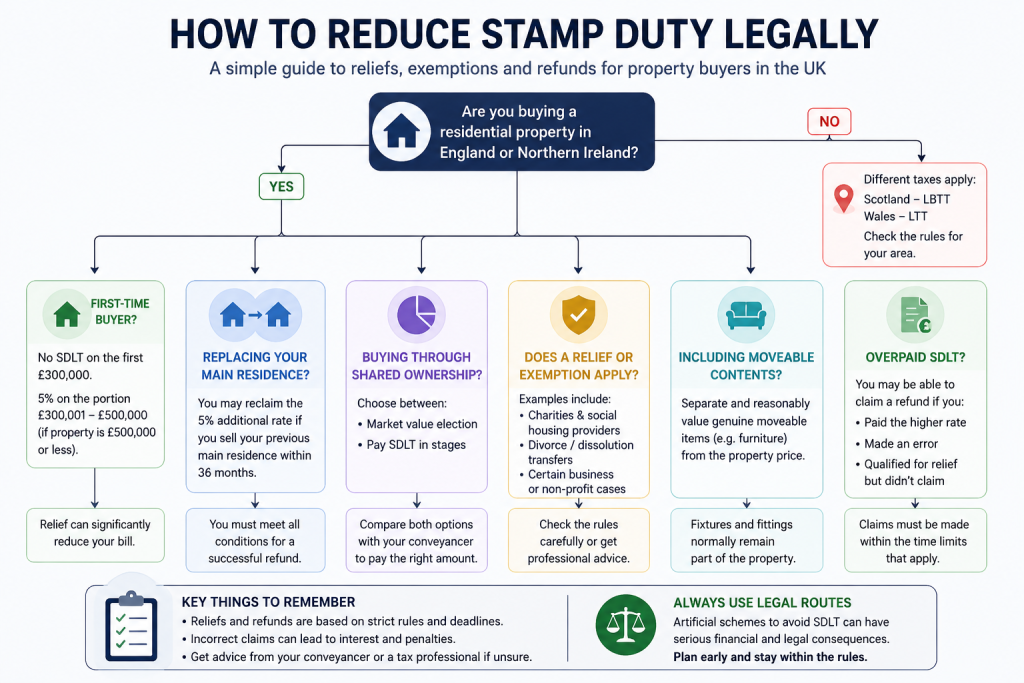
The safest way to pay less Stamp Duty is to establish whether the transaction qualifies for an existing relief, exemption, lower rate or refund. This should be reviewed before contracts are exchanged rather than after the transaction has completed.
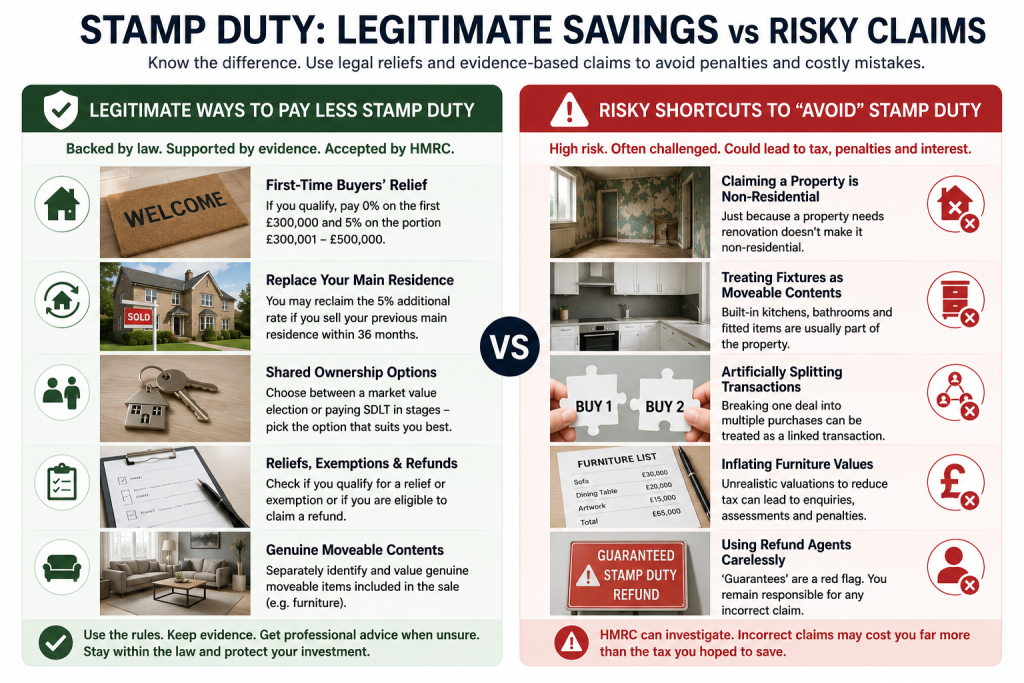
Claim First-Time Buyers’ Relief
You may qualify for First-Time Buyers’ Relief if you and every person purchasing with you have never previously owned an interest in a residential property anywhere in the world and you intend to occupy the new property as your main residence.
For qualifying purchases:
- No SDLT is charged on the first £300,000.
- SDLT is charged at 5% on the portion from £300,001 to £500,000.
- If the property costs more than £500,000, First-Time Buyers’ Relief is not available, and the normal rates apply to the full purchase.
Previous ownership through an inheritance, gift or overseas purchase can affect eligibility, even when no mortgage was involved.
Replace Your Main Residence
You will not normally pay the additional-property surcharge when the new property replaces your main residence and the previous main residence has already been sold.
If you buy the new home before selling the old one, the higher rates may initially be payable because you own both properties at the end of the completion day. You may then be able to reclaim the additional-rate element if you dispose of your previous main residence within 36 months and meet the other conditions.
This does not remove the standard SDLT due on the new home. It provides a potential refund of the additional property surcharge.
Compare the Shared Ownership Payment Options
Shared ownership does not automatically mean SDLT is charged only on the share you initially purchase.
Depending on the arrangement, you may be able to:
- Make a market value election and calculate SDLT using the full market value of the property
- Pay SDLT in stages, initially using the lease premium and, where applicable, the net present value of the rent
The most suitable option can depend on the purchase price, rent, planned staircasing and whether First-Time Buyers’ Relief applies. Ask your conveyancer to compare both calculations before submitting the SDLT return.
Check for Genuine Reliefs and Exemptions
Reliefs and exemptions exist for particular buyers and transactions, including certain purchases by charities, registered social housing providers and property traders. Transfers following divorce or the dissolution of a civil partnership may also be exempt when the relevant conditions are met.
A transfer between spouses or civil partners is not automatically free from SDLT. Cash payments, taking responsibility for mortgage debt or other chargeable consideration can still create an SDLT liability.
Check the Property’s Correct Classification
Genuine non-residential or mixed-use property can be taxed differently from an ordinary residential purchase. Examples may include a shop with a separately used flat above it or a property purchased with qualifying commercial land.
A study, spare room used as a home office or land forming part of a home’s garden or grounds will not normally make an otherwise residential purchase mixed-use. Classification must reflect the property’s real characteristics and use rather than a description chosen solely to obtain a lower tax rate.
Purchasing six or more separate dwellings in one transaction is generally treated as a non-residential transaction for SDLT purposes. Multiple Dwellings Relief is no longer available for transactions completed or substantially performed on or after 1 June 2024, apart from limited transitional circumstances.
Review Genuine Movable Contents
SDLT is charged on land, buildings and fixtures forming part of the property. Genuine moveable items included in the purchase, such as freestanding furniture, may be outside the SDLT calculation when they are separately identified and allocated a reasonable open-market value.
Built-in kitchens, fitted bathrooms, boilers and other items forming part of the building cannot simply be reclassified as contents. Inflating the value of furniture or other movable items to reduce the taxable property price can result in additional tax, interest and penalties.
Check Whether You Have Overpaid
A refund may be available when:
- You paid the higher rates before selling your previous main residence
- You paid the non-UK resident surcharge but subsequently met the qualifying residence conditions
- A valid relief or exemption was omitted from the original return
- The wrong property rates were used
- The SDLT calculation or payment contained an error
Refund routes and deadlines vary according to the reason for the claim. You remain responsible for the accuracy of a claim even when an agent submits it for you.
Stamp Duty Saving Example
Consider an eligible first-time buyer purchasing a main residence for £425,000.
With First-Time Buyers’ Relief:
- 0% is charged on the first £300,000.
- 5% is charged on the remaining £125,000.
- The SDLT bill is £6,250.
Without the relief, the standard residential calculation would be:
- 0% on the first £125,000
- 2% on the next £125,000
- 5% on the remaining £175,000
- Total SDLT of £11,250
In this example, correctly claiming First-Time Buyers’ Relief reduces the SDLT bill by £5,000.
Stamp Duty Strategies That May Not Work
Some arrangements advertised as Stamp Duty savings can create significant tax and legal risks.
Be cautious about:
- Claiming that a property is non-residential solely because it requires repairs
- Treating fitted fixtures as removable contents
- Assigning an unrealistic value to furniture
- Separating transactions that are actually part of one linked arrangement
- Relying on Multiple Dwellings Relief for a current transaction
- Assuming a transfer between family members is automatically exempt
- Believing that buying through a limited company automatically reduces SDLT
- Using a refund agent without understanding the basis of the claim
HMRC can investigate an SDLT return or repayment claim after money has been refunded. If a claim is incorrect, the purchaser may have to repay the tax together with interest and any applicable penalties.
The Benefits of Stamp Duty Planning
Engaging in comprehensive stamp duty planning offers numerous benefits beyond immediate tax savings. One of the most significant advantages is the potential for long-term financial savings. By effectively managing your stamp duty liabilities, you can allocate more funds towards your property investment, enhancing your overall return on investment.
Additionally, well-structured stamp duty planning can enhance your property investment strategies. By understanding the implications of stamp duty on your purchases, you can make more informed decisions that align with your financial goals. This strategic approach can lead to a more robust property portfolio and improved cash flow management.
Furthermore, effective planning provides peace of mind during property transactions. Knowing that you have taken all necessary steps to minimise your tax liabilities can alleviate stress and allow you to focus on other aspects of your investment strategy. This confidence can be particularly valuable in high-stakes transactions where every penny counts.
Common Myths About Stamp Duty Savings
Despite the potential for savings, several myths surrounding stamp duty persist, leading to confusion among property buyers. One common misconception is that all methods of reducing stamp duty are illegal or unethical. In reality, many strategies for stamp duty savings in the UK are entirely legitimate and encouraged by the government.
Another myth is that tax advisors are unnecessary for stamp duty planning. While some buyers may feel confident navigating the system independently, the complexities of tax law often require expert guidance. A qualified tax advisor can help identify opportunities for savings that may not be immediately apparent, ensuring that you comply with all regulations while maximising your benefits.
Lastly, there is a belief that avoidance schemes are a safe route to reducing stamp duty. However, these schemes can lead to significant legal issues and penalties if they do not comply with tax laws. It is essential to utilise legitimate strategies and seek professional advice to avoid the risks associated with avoidance schemes.
What to Check Before Exchanging Contracts
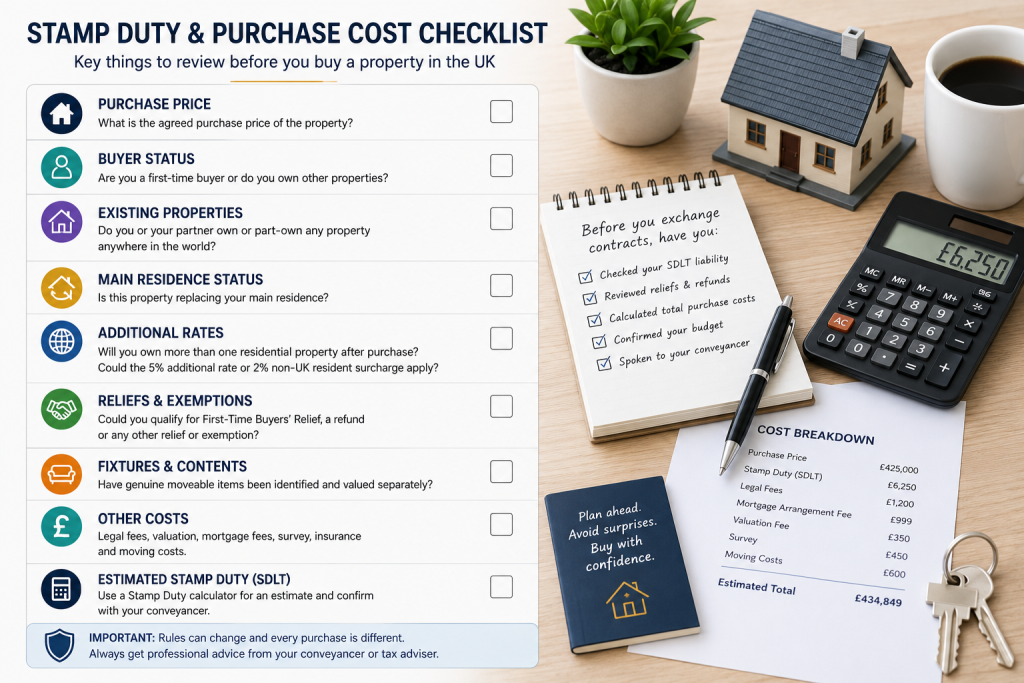
Review these points with your conveyancer before committing to the purchase:
- Confirm whether SDLT, LBTT or LTT applies to the property.
- Calculate the tax using the final agreed purchase price.
- Confirm whether every buyer qualifies as a first-time buyer.
- Declare residential properties owned or part-owned anywhere in the world.
- Consider the property ownership of a spouse or civil partner.
- Confirm whether the purchase replaces your main residence.
- Check whether the additional-property surcharge applies.
- Check whether the non-UK resident surcharge applies.
- Review the correct treatment of shared ownership rent and staircasing.
- Identify any genuine movable contents included in the price.
- Confirm whether multiple purchases could be treated as linked.
- Obtain written advice before claiming a specialist relief or lower property classification.
- Include SDLT, legal fees, valuation costs and finance fees in your overall purchase budget.
Completing these checks early can prevent an unexpected shortfall immediately before completion.
How Lockwell Finance Can Help You
Stamp Duty is only one part of the money required for a property purchase. Your deposit, legal fees, valuation costs, lender fees, refurbishment budget and finance structure can all affect how much cash you need at completion.
Lockwell Finance can help you review suitable mortgage and property finance options, estimate the broader costs of the purchase and understand how the SDLT estimate affects your funding requirement.
For a binding assessment of your SDLT liability or eligibility for a relief, ask your conveyancer or a suitably qualified property tax adviser to review the transaction before contracts are exchanged.
Plan the Full Cost of Your Property Purchase
Tell us the property type, purchase price, deposit, intended use and expected completion date. Our team can review suitable finance options and help you understand the likely funding required to proceed.
Speak to an adviser about your property finance options.
Questions Buyers Often Ask
How can I legally avoid Stamp Duty on a house purchase?
You may pay no SDLT when the purchase is below the relevant threshold or qualifies for a valid relief or exemption. Otherwise, the tax cannot simply be avoided. The correct approach is to check whether you qualify for First-Time Buyers’ Relief, a main-residence surcharge refund or another established provision.
How can I pay less Stamp Duty legally?
Start by confirming your buyer status, the correct property classification, whether the purchase replaces your main residence and whether any valid relief applies. Shared ownership payment choices and genuine movable contents may also affect the calculation in appropriate cases.
Do first-time buyers pay Stamp Duty?
Eligible first-time buyers purchasing a main residence for £500,000 or less pay no SDLT on the first £300,000 and 5% on the portion from £300,001 to £500,000. If the price exceeds £500,000, the relief is unavailable.
Can I claim First-Time Buyers’ Relief if the other buyer has owned a property?
No. Every person purchasing the property must meet the first-time buyer conditions. Previous ownership of residential property outside the UK can also prevent a purchaser from qualifying.
Can I avoid the additional-property surcharge by selling my old home later?
If you buy your new main residence before disposing of your previous one, you will normally pay the higher rates at completion. You may be able to reclaim the additional-rate element if the former main residence is sold within 36 months and the relevant conditions are met.
Does shared ownership reduce Stamp Duty?
It can change when and how SDLT is paid, but it does not automatically eliminate the tax. Buyers normally choose between a market value election and paying in stages. The rent and later purchase of additional shares can also affect the calculation.
Can furniture be removed from the SDLT calculation?
Genuine movable contents may be separately valued at a reasonable open-market amount. Fixtures and items forming part of the building remain chargeable. An artificial or inflated allocation can be challenged by HMRC.
Can I still claim Multiple Dwellings Relief?
Multiple Dwellings Relief was abolished for transactions completing or substantially performed on or after 1 June 2024, subject to limited transitional rules. A purchase of six or more separate dwellings in a single transaction may instead be treated under the non-residential rules.
Does buying through a limited company reduce Stamp Duty?
Not automatically. Companies purchasing residential property usually pay the higher residential rates, and certain corporate purchases of dwellings worth more than £500,000 can be subject to a separate 17% rate unless an applicable relief is available.
Is a property treated as non-residential if it needs renovation?
Not merely because repairs or modernisation are needed. A property that retains the fundamental characteristics of a dwelling will normally remain residential for SDLT purposes, even when work is required before occupation.
Does Stamp Duty Land Tax apply throughout the UK?
No. SDLT applies to purchases in England and Northern Ireland. Scotland uses Land and Buildings Transaction Tax, while Wales uses Land Transaction Tax.
Can a Stamp Duty refund claim be checked after HMRC pays it?
Yes. Payment of a refund does not necessarily mean HMRC has accepted that the claim is correct. HMRC may subsequently review the claim, and an incorrect repayment may have to be returned with interest and applicable penalties.
