



Can you get a Buy-to-Let mortgage on a leasehold flat? Potentially, yes. Lenders may consider it, but the remaining lease term, service charges, ground rent, subletting conditions and building safety evidence can affect eligibility. There is no universal lease-length or deposit requirement for every lender.
Unlike freehold ownership, a leasehold flat has a fixed unexpired lease term and obligations set out in the lease. These may include service charges, ground rent, subletting conditions and contributions to major works. Not every lease has a monetary ground rent: many qualifying new long residential leases granted since 30 June 2022 are restricted to a peppercorn rent. These terms can affect lending, net rental income, resale and refinancing.
This guide covers leasehold Buy-to-Let lending in England and Wales, including short leases, extension rules, costs and landlord restrictions. For finance options see Lockwell’s Buy-to-Let mortgage hub or start a property finance enquiry. Scottish land ownership rules are different.
Confirm the years remaining at completion and any lender requirement beyond the mortgage term.
Ask a solicitor to check the lease for subletting restrictions, written consent and any licence fees.
Request service-charge accounts, ground-rent reviews, reserve-fund figures and planned major works.
Check relevant cladding and safety records and whether the intended lender needs further evidence.
Important: A mortgage lender accepting a property does not override restrictions in the lease or remove the buyer’s legal due-diligence obligations.
What Is a Leasehold Buy-to-Let Mortgage?
A leasehold BTL mortgage is a mortgage designed for landlords purchasing a leasehold property to rent out to tenants.
With leasehold ownership, you own the property for a fixed number of years under a lease agreement, but not the land it stands on. Ownership eventually reverts to the freeholder once the lease expires unless it is extended.
Common leasehold properties include:
- Flats and apartments
- Maisonettes
- Some new-build houses
- Ex-council properties
- Retirement apartments
Many Buy-to-Let lenders consider leasehold flats, subject to the exact property, lease wording, landlord/borrower profile and rental assessment. A leasehold title is not automatically unacceptable, but additional legal and valuation checks may apply.
Why Leasehold Properties Are Popular With Landlords
Despite additional complexity, leasehold properties remain attractive investments for many landlords.
Lower Purchase Prices
Leasehold flats are often cheaper than freehold houses in the same location, reducing entry costs for investors.
Strong Rental Demand
Apartments in major UK cities frequently attract:
- Young professionals
- Students
- Corporate tenants
- International renters
Better Urban Locations
Leasehold properties are commonly located near:
- Transport hubs
- Universities
- Business districts
- Regeneration zones
Lower Maintenance Responsibility
The freeholder or management company often organises common-area and structural maintenance, but leaseholders normally help pay for it through service charges, reserve-fund contributions and sometimes unexpected major-works bills. This can reduce direct maintenance administration, not necessarily the overall cost.
How Lenders Assess a Leasehold BTL Mortgage
Mortgage lenders assess leasehold properties differently from freehold properties because lease terms and ongoing costs affect security value.
Remaining Lease Length
This is one of the most important factors.
Lenders apply their own unexpired-lease requirements. They may assess the years remaining at completion and the period left when the mortgage ends. There is no reliable single minimum for every lender. As one published example, The Mortgage Works’ UK Finance handbook criteria specify at least 70 years unexpired at completion and 30 years left at the end of the mortgage term for the relevant lending policy. Other lenders and mortgage products can differ, so verify the current criteria.
- The individual lender’s minimum remaining lease term at completion
- Whether a specialist lender will consider a shorter lease or a lease extension alongside completion
- Any lender-specific minimum years remaining beyond the proposed mortgage maturity
A shortening lease can reduce mortgageability, marketability and value; the effect depends on the property, local market and the ability and cost to extend the lease.
Ground Rent
Lenders now scrutinise escalating ground rent clauses carefully.
Problematic leases may include:
- Ground rent doubling every 10 years
- High annual increases
- Onerous review periods
Some lenders reject problematic ground-rent terms or require a deed of variation. For qualifying new long residential leases granted on or after 30 June 2022, ground rent is generally limited to a peppercorn (effectively zero), but buying an existing older lease does not automatically remove its ground-rent obligation. See GOV.UK guidance on ground rent and service charges.
Service Charges
Service charges reduce rental profitability and affect affordability calculations.
Lenders consider:
- Annual maintenance fees
- Reserve fund contributions
- Building insurance costs
- Upcoming major works, Section 20 consultation notices and how these costs will be funded
Rental Coverage
Interest Coverage Ratio (ICR) and stress-testing criteria depend on the lender, borrower and product. Figures such as 125% and 145% are examples used by some products, not a guaranteed range for every mortgage.
For example:
- Monthly mortgage interest: £1,000
- Required rental coverage at 145%: £1,450+
Property Type
Certain leasehold properties can be harder to finance, including:
- Ex-local authority flats
- High-rise buildings
- Studio apartments
- Properties above commercial units
What Is Considered a Short Lease for BTL Mortgages?
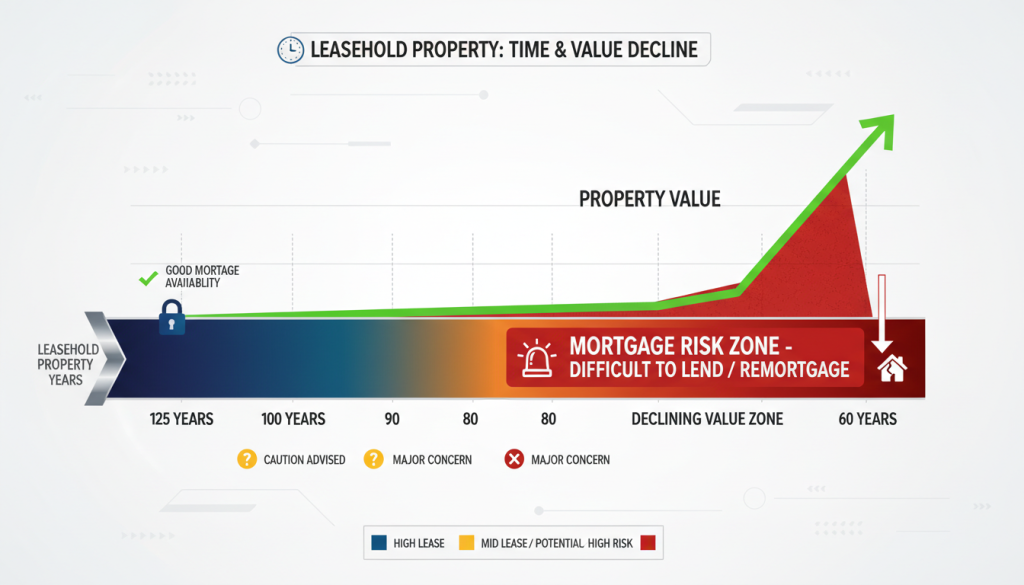
The 80-year threshold is significant in England and Wales for statutory lease-extension valuation, but it is not a universal mortgage lender cut-off. Some lenders require more years remaining or consider the proposed mortgage term as well.
Once a lease falls below 80 years:
- Mortgage options may become more limited
- Valuation and resale may become more difficult
- A statutory extension premium may increase, particularly where marriage value applies
- Buyer and lender appetite may be narrower
Current position, November 2026: for qualifying statutory flat lease extensions, a lease with 80 years or fewer remaining when the formal notice is served can involve marriage value in the premium. The Leasehold and Freehold Reform Act 2024 proposes removing marriage value, but that valuation reform and the new 990-year extension term have not yet commenced. The current statutory flat route generally adds 90 years at a peppercorn ground rent. See the Leasehold Advisory Service’s current reforms tracker.
Can You Get a Buy-to-Let Mortgage on a Short Lease Property?
Sometimes. A shorter lease can limit available lenders, valuation, future remortgaging and resale. Ask a solicitor to confirm the exact unexpired term and any extension arrangements before relying on a finance illustration.
Some specialist lenders may consider:
- A remaining lease length acceptable to that specific specialist lender
- Experienced landlords
- Higher deposits
- Strong rental yields
However, landlords should carefully assess long-term costs before purchasing.
Common Short Lease Challenges
| Issue | Impact |
|---|---|
| Fewer lenders | Reduced mortgage choice |
| Higher rates | Increased borrowing costs |
| Lower valuations | Reduced loan sizes |
| Difficult refinancing | Future remortgage issues |
| Lower resale appeal | Smaller buyer pool |
Lease Extension Costs: What Landlords Must Consider
Lease extensions can be expensive, especially in high-value areas.
Costs may include:
- Premium paid to freeholder
- Solicitor fees
- Valuation fees
- Land Registry charges
- Freeholder legal costs
The lease-extension premium and professional costs depend on property value, current lease length, ground rent and the legal route. A professional valuer should assess any marriage value under current rules; costs should not be inferred from a generic location-based estimate.
The former two-year ownership requirement for qualifying statutory flat lease-extension claims was abolished on 31 January 2025. Other qualification and procedure rules still apply. A newly registered qualifying leaseholder may start the statutory process without the former two-year wait, but needs a solicitor and specialist valuer to assess the notice, timing and premium. See LEASE’s formal extension guide.
Typical Deposit Requirements for Leasehold Landlord Finance
There is no uniform deposit percentage for all leasehold Buy-to-Let properties. The required deposit or equity depends on a lender’s maximum loan-to-value (LTV), rental assessment, valuation, lease conditions and borrower criteria.
- The actual lender’s acceptable maximum LTV for this property and borrower
- Whether a short lease or building-specific risk restricts borrowing or prevents a mortgage
- Affordability and rent stress-testing, not just the available cash deposit
Factors affecting deposit size include:
- Property location
- Lease term
- Credit history
- Rental yield
- Property condition
Leasehold Flats vs Freehold Houses for Landlords
| Factor | Leasehold flat | Freehold house |
|---|---|---|
| Purchase price | Depends on lease, condition and location | Depends on property, condition and location |
| Service or estate charges | Usually building service charges and possibly reserve funds | May still have estate-management charges |
| Ground rent | May apply to older leases; most qualifying new leases are peppercorn | Not usually payable for a freehold title |
| Repairs | Common works organised by managing parties and recharged | Generally arranged and paid for directly by owner |
| Lease expiry | Unexpired term and possible extension cost are relevant | No diminishing lease term for the freehold title |
| Mortgage due diligence | Lease term, subletting, charges, building condition and valuation | Title, property condition, valuation and borrower criteria |
Both can perform well as investments depending on strategy and location.
Hidden Costs Many Landlords Overlook
Many first-time investors focus solely on mortgage payments and rental income.
However, leasehold properties often include additional costs that impact profitability.
Common Costs Include
- Service charges
- Ground rent
- Building insurance contributions
- Managing agent fees
- Section 20 major works and reserve-fund shortfalls
- Lease extension premiums and professional costs
- Licence to let fees
Unexpected works can materially affect cash flow. In England and Wales, Section 20 consultation generally applies when qualifying works would cost any one leaseholder more than £250, or a qualifying long-term agreement more than £100 a year. This is a consultation threshold, not a £250 cap on valid works charges. Review current notices and planned projects; see LEASE’s Section 20 guidance.
How Service Charges Affect Rental Yield

High service charges can reduce cash flow substantially.
For example:
| Annual Rent | £18,000 |
|---|---|
| Mortgage Costs | £10,500 |
| Service Charges | £3,000 |
| Ground Rent | £350 |
| Illustrative cash surplus before tax and other costs | £4,150 |
This £4,150 figure is not net profit. It deducts only the illustrated mortgage payments, service charge and ground rent from £18,000 annual rent; it excludes void periods, letting fees, repairs, insurance not included in service charges, compliance costs, major works and tax. If mortgage repayments include capital, accounting profit and taxable profit may also differ from cash flow. Modern developments with concierge services, gyms or lifts can have substantial management charges.
Landlords should request a full service charge history before proceeding.
Buying an Ex-Council Leasehold Flat
Ex-council properties can offer strong rental yields and lower purchase prices.
However, lenders may apply restrictions based on:
- Number of storeys
- Construction type
- Local authority ownership percentage
- Cladding concerns
- Building condition
Some lenders apply height, construction, access, tenancy or valuation restrictions to certain buildings; others may consider them with suitable evidence. Check the actual lender’s criteria and any outstanding fire-safety remediation plan.
Cladding and EWS1 Requirements
Where fire safety or cladding is relevant, a lender or valuer may request an EWS1 assessment or other suitable building-safety evidence. Not every building requires an EWS1, and the form is a valuation-related external-wall assessment, not a government safety certificate. RICS’ second edition of the professional guidance took effect on 1 November 2026; read the RICS guidance and check the lender’s current policy.
Without acceptable fire safety documentation:
- Mortgage approval may be delayed
- Valuations may be reduced
- Sales can collapse
This remains a major consideration for apartment investors.
Leasehold Restrictions That Affect Landlords
Some leases include restrictions that limit rental flexibility.
These may include:
- No Airbnb or short lets
- Pet restrictions
- Subletting approval requirements
- Tenant type limitations
- Alteration restrictions
Ask a solicitor to confirm whether the intended letting is permitted, whether freeholder consent or a subletting licence is required, and whether HMO or short-let use is restricted. A mortgage offer cannot override the lease. The Leasehold Advisory Service explains leasehold subletting restrictions.
Interest Rates for Leasehold BTL Mortgages
Leasehold properties do not automatically mean higher mortgage rates, but short leases or high-risk buildings can increase pricing.
Rates are influenced by:
- Deposit size
- Credit score
- Rental income
- Lease term
- Property type
- Landlord experience
Lease terms, building risks and lender policy can limit eligibility even for experienced landlords. Assess the total borrowing costs rather than assuming a better rate is guaranteed.
Limited Company Leasehold BTL Mortgages
Some landlords acquire rental property through a dedicated limited company or SPV. Whether that is appropriate depends on tax, finance, administrative and ownership considerations, not the leasehold status alone.
Benefits may include:
- Different company-tax and mortgage-interest treatment from personal ownership
- Potential separation of investment assets and accounting records
- Different finance products, fee structures and possible personal-guarantee requirements
- Possible estate or succession planning considerations requiring specialist tax and legal advice
SPV mortgage criteria, guarantees, tax and administration can differ from personal ownership. A company does not guarantee a better mortgage or lower overall tax. See our SPV Buy-to-Let guide and consult a tax adviser before choosing an ownership structure.
Common Mistakes Landlords Make With Leasehold Properties
Ignoring Lease Length
Many investors underestimate how quickly a lease depreciates.
Underestimating Service Charges
Service charges can increase dramatically over time.
Failing to Check Ground Rent Clauses
Onerous leases can affect future mortgageability.
Not Reviewing Major Works Notices
Large building repairs can create unexpected costs.
Buying Without Specialist Advice
Leasehold investing involves legal and financial complexity that requires expert guidance.
How to Improve Mortgage Approval Chances
Landlords can strengthen applications by:
- Checking the actual lender’s lease-term test and the years remaining at loan maturity
- Keeping strong credit profiles
- Providing larger deposits
- Demonstrating rental income potential
- Working with specialist BTL mortgage brokers
- Avoiding problematic lease clauses
Hypothetical Leasehold Flat Cost Illustration
Scenario
- Purchase price: £240,000
- Deposit: 25%
- Mortgage: £180,000
- Annual rent: £19,200
- Service charge: £2,400
- Ground rent: £250
Outcome
Although the rental yield initially appeared attractive, net profitability reduced after management costs and leasehold expenses were included.
This is an illustrative scenario, not an actual borrower result or promised return. The example assumes favourable circumstances such as:
- Strong tenant demand
- Excellent transport links
- Long lease term
- High occupancy rates
Rental voids, repairs, taxes, financing and major-works costs could produce a much lower or negative return. Do not treat these figures as a lender quote or evidence of investment performance.
Why Many Investors Still Prefer Leasehold Flats

Despite added complexity, leasehold properties remain a core part of many landlord portfolios.
Key reasons include:
- Lower entry costs
- Strong city demand
- Consistent tenant pools
- Easier diversification
- Potential capital appreciation in regeneration areas
The eventual return depends on rent, purchase price, lease restrictions, financing, voids, building costs and resale value; it is not guaranteed by the property being leasehold or in a high-demand location.
How Lockwell Finance Can Help
Finding the right leasehold BTL mortgage requires specialist knowledge of:
- Short lease lending
- Rental stress testing
- Limited company structures
- Ex-council lending
- Portfolio landlord finance
- Complex property scenarios
Lockwell Finance can discuss the investment-finance requirements of a leasehold purchase or refinance, including the information lenders may need about the building, lease, property value and projected rent.
For a purchase or portfolio refinance, start by confirming the remaining lease term, any letting restrictions, major-works exposure and the intended repayment strategy. Any finance remains subject to lender criteria, valuation and satisfactory legal documentation.
Why Landlords Choose Lockwell Finance
- Access to specialist BTL lenders
- Support for complex leasehold cases
- Guidance on short lease properties
- Limited company mortgage expertise
- Fast application support
- Experienced property finance advisers
Considering a leasehold rental flat? Send Lockwell Finance a leasehold Buy-to-Let enquiry with the property postcode, price or value, unexpired lease term, estimated rent, service charge, ground rent, deposit and any building-safety information. Finance remains subject to lender criteria and valuation. Lockwell states that its advice is not FCA regulated; seek appropriately authorised advice where a regulated mortgage is involved.
Frequently Asked Questions
Can you get a leasehold BTL mortgage with a short lease?
Potentially, subject to the lender’s actual lease security policy, the proposed mortgage term, valuation and any acceptable extension plan. A larger deposit does not override a prohibited lease or building condition.
What is the minimum lease length for a buy-to-let mortgage?
There is no universal number: lenders can set their own minimum unexpired lease at completion and sometimes a required period beyond the mortgage term. The statutory 80-year marriage-value threshold is a different issue.
Are leasehold flats harder to mortgage than freehold houses?
They can involve more legal checks and restrictions, but a leasehold flat is not automatically harder to finance. The remaining term, service charges, ground rent, subletting provisions and building condition influence the lender’s decision.
Do service charges affect buy-to-let affordability?
They may. Lenders can assess affordability and rental coverage in different ways, but service charges reduce the landlord’s net cash flow and can influence the valuation and investment decision.
Can you extend the lease after buying a rental property?
Yes, if eligible. The two-year ownership rule was removed on 31 January 2025, so a newly registered qualifying flat leaseholder can start the formal process. As of November 2026, the proposed removal of marriage value and new 990-year statutory extension term have not yet commenced. A specialist solicitor and valuer should check the appropriate route and likely costs.
Is a leasehold flat a good investment property?
It can be. Many leasehold flats generate strong rental demand in urban areas, particularly near transport links and universities.
Reviewed 2 November 2026. This article is general information for England and Wales, not individual mortgage, tax or legal advice. Lender criteria and leasehold legislation can change. Your property may be repossessed if you do not keep up repayments on a mortgage or another debt secured against it.