


Buying a property in the UK while living overseas can feel complicated, especially if you are unsure which lenders will consider your application, how your foreign income will be assessed, or what documents you need to provide. The good news is that UK mortgages can be available to non-UK residents, expats, foreign nationals, and overseas investors, but the right route depends on your circumstances.
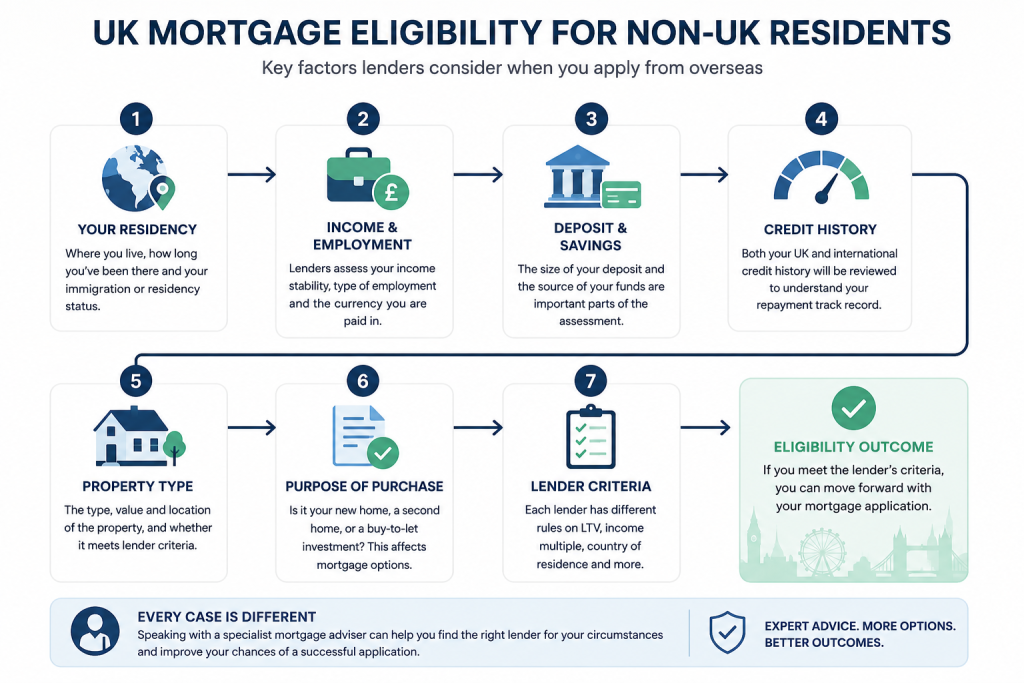
Lenders will usually look at your residency status, country of residence, income, deposit, credit history, property type, and whether the purchase is for personal use or as a buy-to-let investment. Because criteria vary widely between lenders, preparing the right documents and choosing the right mortgage route can make a significant difference.
This guide explains how UK mortgages for non-UK residents work, what lenders usually check, which mortgage options may be available, and how to improve your chances of a smoother application from abroad.
Can a Non-UK Resident Get a UK Mortgage?
Yes, it can be possible for a non-UK resident to get a mortgage on a UK property, but the application is usually assessed more carefully than a standard UK-resident mortgage. Lenders will normally look at where you live, where your income is earned, the currency you are paid in, your deposit, your credit profile, the property type, and whether the purchase is for your own use or as a buy-to-let investment.
A non-resident mortgage is not one single product. The right route depends on your situation. A British expat buying a UK rental property may be assessed differently from a foreign national buying a home to live in later, or an overseas investor purchasing through a company. This is why lender selection and document preparation matter from the start.
Lockwell Finance helps overseas buyers, expats, foreign nationals, and property investors understand which mortgage routes may be realistic before an application is submitted.
Understanding UK Mortgages for Non-UK Residents
A non-resident UK mortgage is a financial product designed for individuals who do not reside in the UK but wish to purchase property within the country. This type of mortgage allows overseas buyers to access the UK property market, which can be an attractive investment opportunity given the UK’s stable real estate market. However, securing a mortgage as a non-UK resident comes with its own set of challenges and specific eligibility criteria that must be met.
Eligibility for a non-resident UK mortgage typically includes several factors. Firstly, lenders often require a minimum income threshold, which can vary significantly between institutions. Generally, non-residents are expected to demonstrate a stable income, often starting at around £50,000 per year, although this can differ based on the lender’s policies.
Additionally, lenders will assess the applicant’s credit history, which may be challenging for individuals who have not established credit in the UK. Some lenders may consider international credit reports, while others might require a substantial deposit, often ranging from 20% to 40% of the property’s value. This higher deposit requirement is a common practice to mitigate the perceived risk of lending to non-residents.
Furthermore, the type of property being purchased can influence eligibility. For instance, some lenders may restrict mortgages to residential properties or specific types of buy-to-let investments. Understanding these criteria is essential for non-UK residents looking to navigate the mortgage landscape successfully.
Who Counts as a Non-UK Resident Mortgage Applicant?
You may be treated as a non-UK resident mortgage applicant if you live outside the UK, earn income abroad, pay tax overseas, or do not have a strong recent UK address and credit history. Some applicants are British citizens living abroad, while others are foreign nationals buying UK property from overseas.
Common applicant types include:
- British expats living and working overseas
- Foreign nationals buying UK property
- Overseas investors purchasing buy-to-let property
- UK citizens paid in foreign currency
- Applicants with limited UK credit history
- Buyers planning to move to the UK in the future
- Applicants with settled or pre-settled status
- Joint applicants where one person lives outside the UK
Lenders may use different definitions, so it is important to check the criteria before assuming you qualify.
Types of Mortgages Available for Non-UK Residents
When considering a UK mortgage as a non-resident, there are two primary types of mortgages available: fixed-rate and variable-rate mortgages. Each type has its advantages and disadvantages, and the choice between them can significantly impact the overall cost of borrowing.
Fixed-rate mortgages offer stability and predictability, as the interest rate remains constant throughout the loan term. This means that monthly payments will not fluctuate, making it easier for borrowers to budget. Fixed-rate mortgages are particularly appealing in a rising interest rate environment, as they protect borrowers from potential increases in borrowing costs.
On the other hand, variable-rate mortgages have interest rates that can change based on market conditions. These rates are often linked to a base rate, such as the Bank of England’s base rate, and can fluctuate, leading to varying monthly payments. While variable-rate mortgages may start with lower initial rates, they carry the risk of increasing costs if interest rates rise.
In addition to these standard options, there are specialized mortgage products tailored for overseas buyers. For example, some lenders offer expat mortgages designed specifically for UK citizens living abroad, which may have more lenient criteria regarding income verification and credit history. Others may provide buy-to-let mortgages that cater to investors looking to purchase rental properties in the UK, often with different terms and conditions compared to residential mortgages.
Understanding the nuances of these mortgage types is crucial for non-UK residents. By carefully evaluating the available options, borrowers can select a mortgage that aligns with their financial goals and risk tolerance.
Mortgage Options by Buyer Type
British Expats
British expats may be able to apply for a UK mortgage while living abroad. Lenders will usually want to understand your country of residence, employment status, income currency, tax position, UK credit history, deposit, and whether the property will be used as a home or rental investment.
Foreign Nationals
Foreign nationals can sometimes obtain UK mortgages, but the available options depend on residency status, visa position, income, deposit, and credit profile. Some lenders are more comfortable with applicants who already live in the UK, while others may consider overseas buyers in selected countries.
Overseas Buy-to-Let Investors
Buy-to-let mortgages can be available to non-UK residents, especially where the property has strong rental demand and the deposit is sufficient. The lender will normally assess the expected rent, loan-to-value, property type, borrower profile, and wider investment structure.
Buyers with Settled or Pre-Settled Status
Applicants with settled or pre-settled status may have more options than applicants with no UK residency status, but lender criteria still vary. The lender may consider how long you have lived in the UK, your employment, income, address history, deposit, and credit record.
Joint Applicants
A joint mortgage with a non-UK resident may be possible, but the lender will assess both applicants. This can be useful where one applicant has stronger UK income or credit history, but the overseas applicant’s income, documents, and residency position still need to be accepted by the lender.
Residential vs Buy-to-Let Mortgages for Overseas Buyers

The property use is one of the most important parts of the application.
A residential mortgage is usually used when the borrower or their family will live in the property. The lender will focus heavily on personal affordability, income stability, credit history, deposit, and residency position.
A buy-to-let mortgage is used when the property will be rented to tenants. The lender will usually focus on the expected rental income, rental coverage, loan-to-value, property type, landlord experience, and the borrower’s wider financial profile.
For non-UK residents, buy-to-let can sometimes be more accessible than residential borrowing because the rental income is central to the assessment. However, this does not mean approval is automatic. Overseas residency, foreign income, deposit size, and the property itself can still limit lender choice.
Key Requirements for Obtaining a UK Mortgage
Obtaining a UK mortgage as a non-resident involves several key requirements that differ from those for UK residents. The documentation needed is critical in demonstrating financial stability and the ability to repay the mortgage.
Firstly, applicants must provide proof of identity, which typically includes a valid passport and possibly additional identification, such as a driver’s license or national ID card. This is essential for verifying the applicant’s identity and ensuring compliance with anti-money laundering regulations.
Secondly, proof of income is a vital component of the mortgage application process. Non-residents must present comprehensive documentation to verify their income, which may include recent payslips, tax returns, and bank statements. Some lenders may also require a letter from the employer confirming the applicant’s position and salary.
Credit history is another crucial factor. Many lenders will assess the applicant’s creditworthiness based on their credit report. For non-residents, this may involve providing international credit reports or other financial documents that demonstrate responsible borrowing behavior. Some lenders may also consider the applicant’s assets and liabilities to evaluate their overall financial health.
Additionally, non-residents should be prepared to provide details about the property they wish to purchase, including the property’s value and location. This information helps lenders assess the risk associated with the mortgage and determine the appropriate loan-to-value ratio.
Overall, understanding these requirements is essential for non-UK residents looking to secure a mortgage in the UK. By preparing the necessary documentation and demonstrating financial stability, applicants can improve their chances of approval.
What Lenders Usually Check
When assessing a non-UK resident mortgage application, lenders commonly review:
- Proof of identity and current address
- Country of residence
- Nationality and residency status
- Employment or business income
- Income currency
- Bank statements
- Deposit size and source of funds
- UK and international credit history
- Existing debts and financial commitments
- Property value and property type
- Whether the property is residential or buy-to-let
- Expected rental income, if applicable
- Whether the applicant has UK ties or previous UK address history
The stronger and clearer the application, the easier it is for a lender to assess the case.
Documents to Prepare Before Applying

Preparing documents early can reduce delays. Depending on your circumstances, you may need:
- Passport or national identity document
- Proof of current overseas address
- Proof of UK address history, if available
- Recent payslips or employment contract
- Tax returns or accountant-prepared accounts if self-employed
- Recent personal and business bank statements
- Evidence of deposit and source of funds
- Credit report, where available
- Details of existing mortgages or loans
- Property details and purchase price
- Rental estimate for buy-to-let applications
- Visa, settled status, or pre-settled status evidence, where relevant
Documents may need to be provided in English or supported by certified translations if they are issued in another language.
The Application Process for Non-UK Residents
The application process for a UK mortgage as a non-resident typically involves several steps. Understanding this process can help streamline the experience and increase the likelihood of a successful application.
- Research and Compare Lenders: Begin by researching various lenders that offer mortgages to non-UK residents. Compare their terms, interest rates, and eligibility criteria. This step is crucial for identifying the best options that align with your financial situation.
- Prepare Documentation: Gather all necessary documentation, including proof of identity, income verification, and credit history. Ensure that all documents are up-to-date and accurately reflect your financial status.
- Submit Application: Once you have selected a lender, submit your mortgage application along with the required documentation. This can often be done online or through a mortgage broker.
- Await Approval: After submission, the lender will review your application and documentation. This process may take several days to weeks, depending on the lender’s policies and workload.
- Valuation and Offer: If your application is approved, the lender will conduct a property valuation to determine its market value. Following this, they will issue a formal mortgage offer outlining the terms and conditions.
- Complete Legal Formalities: Engage a solicitor or conveyancer to handle the legal aspects of the property purchase. This includes conducting searches, drafting contracts, and ensuring compliance with legal requirements.
- Finalize Mortgage: Once all legal formalities are complete, finalize the mortgage agreement and prepare for the transfer of funds to complete the property purchase.
Throughout the application process, it is essential to remain transparent and responsive to any requests from the lender. Common pitfalls to avoid include providing incomplete documentation, failing to disclose financial obligations, or neglecting to communicate with the lender regarding any changes in circumstances. By being proactive and organized, non-residents can navigate the application process more effectively.
Applying for a UK Mortgage from Abroad

Applying from outside the UK can be straightforward when the case is prepared correctly. A typical process may look like this:
Step 1: Confirm Your Buyer Profile
Start by clarifying whether you are applying as a non-resident, expat, foreign national, overseas investor, or returning UK resident. This affects which lenders may be suitable.
Step 2: Check the Property Use
Decide whether the property will be your home, a future home, a second home, or a buy-to-let investment. This determines whether a residential or buy-to-let route is more appropriate.
Step 3: Review Deposit and Income
Check how much deposit you have available, where the funds are held, how your income is paid, and whether the income is in sterling or another currency.
Step 4: Prepare Documents
Gather identity, income, bank statement, credit, and source-of-funds documents before the application is submitted.
Step 5: Compare Suitable Lenders
Not every lender accepts overseas applicants. The right lender will depend on your country of residence, income structure, deposit, property type, and purchase plan.
Step 6: Submit the Application
Once the lender route is clear, the application can be submitted with supporting documents. The lender may request additional information during underwriting.
Step 7: Valuation, Offer and Completion
The lender will usually arrange a valuation and complete underwriting before issuing a mortgage offer. Your solicitor will then handle the legal work through to completion.
Buying UK Property from Abroad: What to Consider
Purchasing property in the UK from abroad involves several legal considerations that non-residents must be aware of. Understanding these factors can help ensure a smooth transaction and compliance with UK laws.
Firstly, it is crucial to engage a qualified solicitor or conveyancer who specialises in UK property transactions. They will guide you through the legal process, ensuring that all necessary checks are conducted, and that the transaction adheres to UK property laws.
One of the primary legal considerations is the conveyancing process, which involves transferring ownership of the property from the seller to the buyer. This process includes conducting property searches, checking for any existing liens or encumbrances, and ensuring that the property complies with local regulations.
Additionally, non-residents should be aware of the tax implications associated with purchasing property in the UK. This includes understanding the stamp duty land tax (SDLT), which is payable on property purchases above a certain threshold. Non-residents may also be subject to capital gains tax (CGT) when selling the property, depending on their residency status and the length of ownership.
It is also essential to consider the ongoing costs of property ownership, such as council tax, maintenance fees, and insurance. Non-residents should factor these costs into their budget to avoid any financial surprises after the purchase.
Finally, understanding the local property market dynamics is vital. Researching the area where you intend to buy can provide insights into property values, rental demand, and future growth potential. This information can help you make informed decisions and maximize your investment.
Financing Options Beyond Traditional Mortgages
While traditional mortgages are a common route for financing property purchases, non-UK residents may also explore alternative financing solutions. Understanding these options can provide greater flexibility and potentially lower costs.
One alternative is using cash purchases. If you have sufficient funds available, buying property outright can eliminate the need for a mortgage, simplifying the transaction process. Cash purchases can also make your offer more attractive to sellers, as they typically involve fewer complications compared to financed purchases.
Another option is to consider bridging loans. These short-term loans are designed to provide immediate funding, allowing buyers to secure a property quickly while they arrange long-term financing. Bridging loans can be particularly useful in competitive markets where time is of the essence. However, they often come with higher interest rates and fees, so careful consideration is necessary.
Additionally, non-residents may explore joint ventures or partnerships with local investors. This approach can provide access to local market knowledge and shared financial responsibility, reducing the individual risk associated with property investment.
Lastly, some lenders offer specialised financing products tailored for non-residents, such as expat mortgages or buy-to-let mortgages. These products may have different terms and conditions than standard mortgages, potentially making them more accessible for overseas buyers.
By considering these alternative financing options, non-residents can identify the best approach for their property purchase, aligning with their financial goals and investment strategy.
Tips for Non-UK Residents to Secure the Best Mortgage Rates

Securing the best mortgage rates as a non-UK resident requires careful planning and strategic actions. Here are several tips to enhance your chances of obtaining favorable terms:
- Maintain a Good Credit Score: A strong credit history is crucial for securing competitive mortgage rates. Ensure that you manage your finances responsibly, pay bills on time, and reduce outstanding debts.
- Provide Comprehensive Documentation: Be prepared to submit detailed financial documentation to demonstrate your income, assets, and liabilities. The more transparent you are, the more likely lenders will view you as a low-risk borrower.
- Shop Around: Different lenders offer varying rates and terms. Take the time to compare mortgage products from multiple lenders to find the best deal. Consider working with a mortgage broker who specializes in non-resident mortgages to access a wider range of options.
- Consider a Larger Deposit: Offering a larger deposit can reduce the lender’s risk and may result in lower interest rates. If possible, aim for a deposit of 30% or more to enhance your chances of securing better terms.
- Stay Informed About Market Trends: Understanding current interest rate trends and economic conditions can help you time your mortgage application effectively. If rates are expected to rise, acting sooner may be beneficial.
By implementing these strategies, non-UK residents can improve their chances of securing the best mortgage rates, ultimately reducing the overall cost of borrowing.
Deposit, Costs and Stamp Duty Considerations
Non-UK resident mortgage applicants often need a larger deposit than standard UK-resident borrowers. The exact amount depends on the lender, property type, income profile, country of residence, and whether the mortgage is residential or buy-to-let.
You should also allow for wider purchase costs, including:
- Valuation fees
- Legal fees
- Broker or adviser fees, where applicable
- Survey costs
- Mortgage arrangement fees
- Stamp Duty Land Tax, where applicable
- Buildings insurance
- Foreign exchange costs if your funds are held overseas
- Ongoing management costs for rental properties
If you are buying in England or Northern Ireland and are treated as non-UK resident for stamp duty purposes, additional stamp duty rules may apply. Speak to a tax adviser or solicitor before committing to a purchase.
Common Reasons Applications Are Delayed
Non-resident mortgage applications can take longer when key details are unclear. Common causes of delay include:
- Incomplete income documents
- Bank statements that do not clearly show salary or deposit funds
- Unclear source of deposit
- Income paid in a currency the lender does not accept
- Limited UK credit history
- Property type restrictions
- Rental income not meeting lender calculations
- Missing visa or residency documents
- Documents issued in another language without translation
- Applying to a lender that does not accept the applicant’s country of residence
A well-prepared application can reduce the chance of avoidable delays or declines.
Practical Checklist Before You Apply
Before applying for a UK mortgage as a non-UK resident, check the following:
- Do you know whether the property will be residential or buy-to-let?
- Do you have a clear deposit amount?
- Can you evidence the source of your deposit?
- Is your income stable and easy to document?
- Is your income paid in a currency lenders may accept?
- Do you have recent bank statements ready?
- Do you have any UK credit history?
- Do you know your country of tax residence?
- Have you checked likely stamp duty and purchase costs?
- Have you considered foreign exchange movement if funds are held overseas?
- Have you spoken to a solicitor about the purchase?
- Have you checked lender criteria before applying?
Case Studies: Successful Non-UK Resident Property Purchases
Examining real-life examples of non-residents successfully purchasing property in the UK can provide valuable insights and lessons for prospective buyers. Here are a few notable case studies:
Case Study 1: An Australian Investor
An Australian investor sought to purchase a buy-to-let property in London. Despite initially facing challenges with credit history, the investor worked with a mortgage broker who specialized in expat mortgages. By providing comprehensive documentation of income and assets, the investor secured a mortgage with a competitive interest rate and a 25% deposit. The property has since generated a positive rental yield, demonstrating the potential for overseas investment.
Case Study 2: A Canadian Family
A Canadian family wanted to buy a vacation home in the UK. They opted for a fixed-rate mortgage to ensure stable monthly payments. By maintaining a strong credit score and providing proof of income from their Canadian employer, they successfully secured a mortgage with a 20% deposit. The family now enjoys their holiday home while benefiting from property appreciation in the UK market.
Case Study 3: A UAE Business Owner
A business owner from the UAE aimed to invest in commercial property in the UK. They faced higher deposit requirements due to the nature of commercial lending. However, by leveraging their business assets and providing detailed financial statements, they secured a mortgage with favorable terms. The investment has proven lucrative, highlighting the opportunities available for non-residents in the commercial property sector.
These case studies illustrate the diverse experiences of non-residents in the UK property market. Each buyer faced unique challenges but ultimately achieved their goals through careful planning, thorough documentation, and strategic decision-making.
Why Speak to Lockwell Finance?
Non-UK resident mortgage applications require careful lender matching. The right route depends on your residency position, income, deposit, property type, and long-term plan.
Lockwell Finance can help you understand your options, prepare the right documents, compare suitable lender routes, and move forward with clearer expectations. Whether you are a British expat, foreign national, overseas buyer, or non-resident investor, the aim is to give you practical guidance before you commit time and money to an application.
Speak to an adviser to review your circumstances and get clear next steps.
Questions Clients Often Ask
Can a non-UK resident get a mortgage in the UK?
Yes, some lenders consider mortgage applications from non-UK residents. The available options depend on your country of residence, income, deposit, credit profile, property type, and whether the mortgage is residential or buy-to-let.
Can foreigners get a UK mortgage?
Yes, foreign nationals may be able to get a UK mortgage, but criteria vary by lender. Your visa or residency status, income, deposit, address history, and credit profile will all affect the options available.
Can expats get a mortgage in the UK?
Yes, British expats can sometimes get UK mortgages while living abroad. Lenders will usually assess country of residence, income currency, employment, deposit, UK credit history, and whether the property will be used as a home or rental investment.
Can I get a UK mortgage if I live abroad?
It may be possible to get a UK mortgage if you live abroad, but lender choice is usually more limited. Applications from abroad often require stronger documentation, a clear source of deposit, and evidence that income is stable and acceptable to the lender.
Can a non-UK resident get a buy-to-let mortgage?
Yes, buy-to-let mortgages can be available to non-UK residents. The lender will usually assess the property’s expected rent, loan-to-value, deposit, borrower profile, country of residence, and any landlord experience.
Can I get a mortgage without permanent residency?
Some lenders may consider applicants without permanent residency, but the options are usually more limited. Your visa type, time remaining on your visa, income, deposit, and UK credit history can all affect lender choice.
Is a UK mortgage possible with pre-settled status?
It can be possible, depending on the lender. Some lenders may consider applicants with pre-settled status, but they may also review your time in the UK, income, employment, address history, deposit, and credit profile.
Can I get a joint mortgage with a non-UK resident?
A joint mortgage with a non-UK resident may be possible, but the lender must be comfortable with both applicants. The overseas applicant may need to provide additional identity, income, bank statement, and residency documents.
Do non-UK residents need a bigger deposit?
Often, yes. Many lenders ask non-UK resident applicants for a larger deposit because the application can involve additional residency, income, currency, and documentation checks. The exact deposit depends on the lender and the case.
Can I use foreign income for a UK mortgage?
Some lenders may accept foreign income, but not all currencies, countries, or income types are treated the same. You may need payslips, employment letters, tax documents, and bank statements showing the income clearly.
Are UK mortgages for overseas buyers more expensive?
They can be. Non-resident and overseas buyer mortgages may have fewer lender options, higher deposit requirements, different rates, or additional fees. The final cost depends on the lender, property, deposit, income, and overall risk profile.
What is the best way to apply for a UK mortgage from overseas?
The best starting point is to check lender criteria before applying, prepare your documents early, and confirm whether the property is residential or buy-to-let. A specialist adviser can help match your circumstances with lenders that consider overseas applicants.
Need Help Finding a UK Mortgage as a Non-UK Resident?
If you live overseas and want to buy or refinance property in the UK, Lockwell Finance can help you understand your options before you apply. Whether you are an expat, foreign national, overseas investor, or non-resident buyer, our team can review your circumstances, explain suitable lender routes, and help you prepare the right documents.
Speak to Lockwell Finance today to discuss your UK mortgage options and get clear next steps for your application.
